
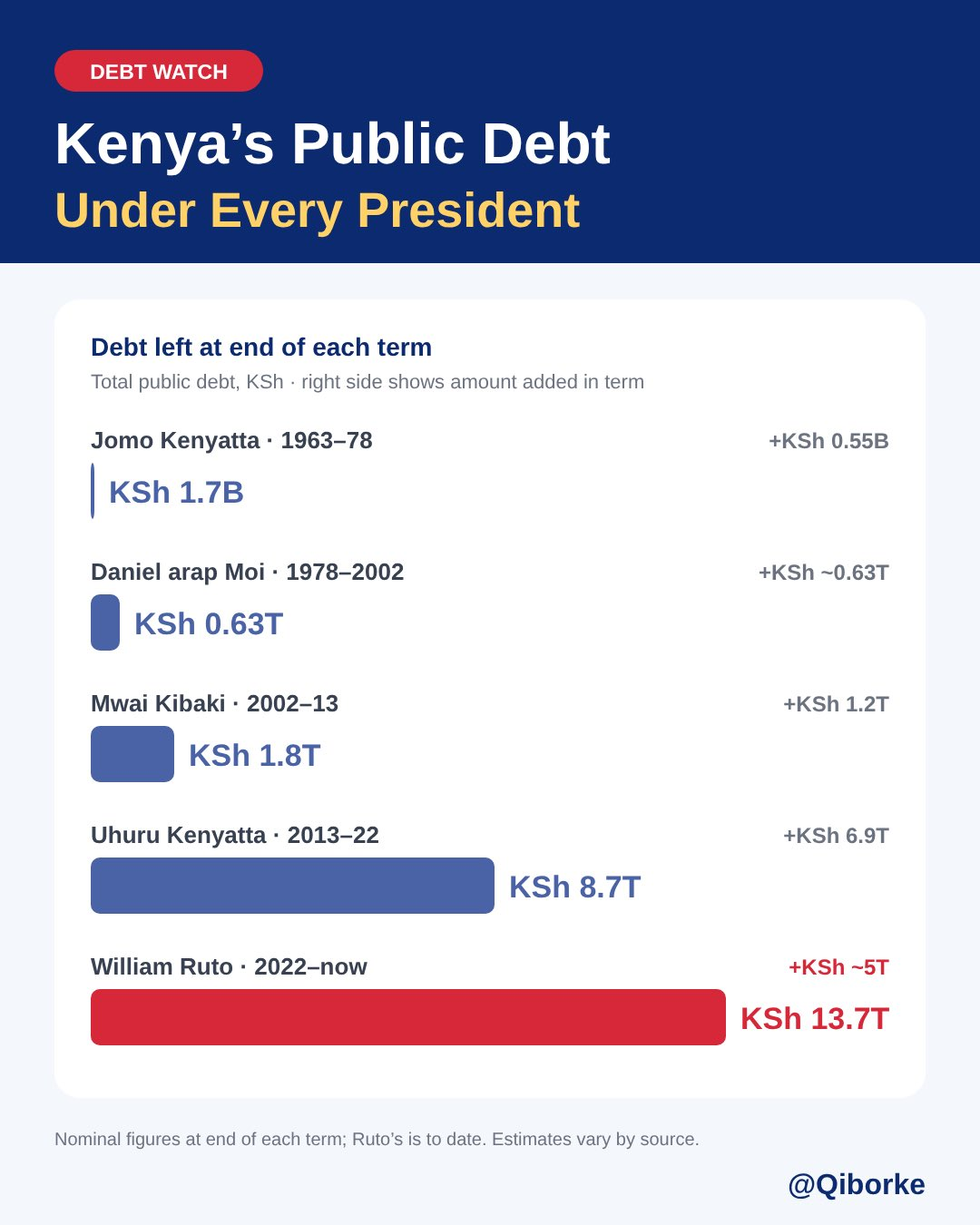
NAIROBI — Kenya’s public debt has climbed to a record Sh13.7 trillion under President William Ruto’s administration, with roughly Sh5 trillion added since he took office in September 2022, according to recent official data and independent trackers. The stock stood at about Sh8.7 trillion when Ruto assumed power, marking the fastest accumulation in a comparable period under any recent presidency.
The increase has pushed Kenya’s debt-to-GDP ratio well above the statutory anchor of 55 percent (in present-value terms). Recent figures place it in the 67–72.5 percent range depending on the measurement date and methodology, with the Controller of Budget and other watchdogs flagging the breach and the high cost of servicing the debt.
Critics argue that rising living costs, limited visible gains from the borrowing, and a growing share of revenue absorbed by interest and principal payments have left ordinary Kenyans worse off. Interest costs alone have consumed a substantial portion of government revenue, often cited around one-third or higher, leaving less room for development spending, education, health, and other priorities. The Controller of Budget, Dr Margaret Nyakang’o, has warned of a “vicious cycle” in which new borrowing is used to service existing obligations, describing the practice as hazardous and noting that in some cases, half of debt payments cover financial costs rather than reducing the principal.
Supporters of the administration and some analysts note that a large share of the new borrowing has refinanced maturing obligations inherited from the Uhuru Kenyatta era, including Eurobonds issued around 2014 and later. Treasury officials have framed liability management, such as Eurobond buybacks and refinancing, as necessary to avoid default and smooth repayment walls, while pointing to fiscal consolidation efforts and plans to fund future infrastructure through vehicles like the National Infrastructure Fund without additional unsustainable debt or taxes.
A November 2026 World Bank Kenya Economic Update has intensified scrutiny. The report estimates that corruption and collusion cost the economy about 2 percent of GDP annually (roughly Sh370 billion or $2.8 billion), widening the fiscal deficit, raising borrowing needs, and discouraging private investment. It identifies weak governance as a key constraint on growth and models significant gains, including higher GDP and job creation, from moderate to ambitious anti-corruption reforms.
The findings have fueled calls from civil society, opposition figures, and fiscal watchdogs for independent audits of past and current borrowing, greater transparency in public procurement, and stronger accountability mechanisms. Domestic debt now makes up a larger share of the total stock (often above 55–58 percent), reducing some external exchange-rate risks but increasing reliance on the local market and raising interest costs.
As the National Treasury prepares the 2027/28 budget amid pledges of fiscal discipline, the debt trajectory remains a central political and economic issue. With debt service projected to remain a major claim on revenue and the ratio still above the legal threshold for the foreseeable future, the balance between refinancing inherited obligations, funding development, and controlling waste will shape Kenya’s fiscal space in the years ahead.