
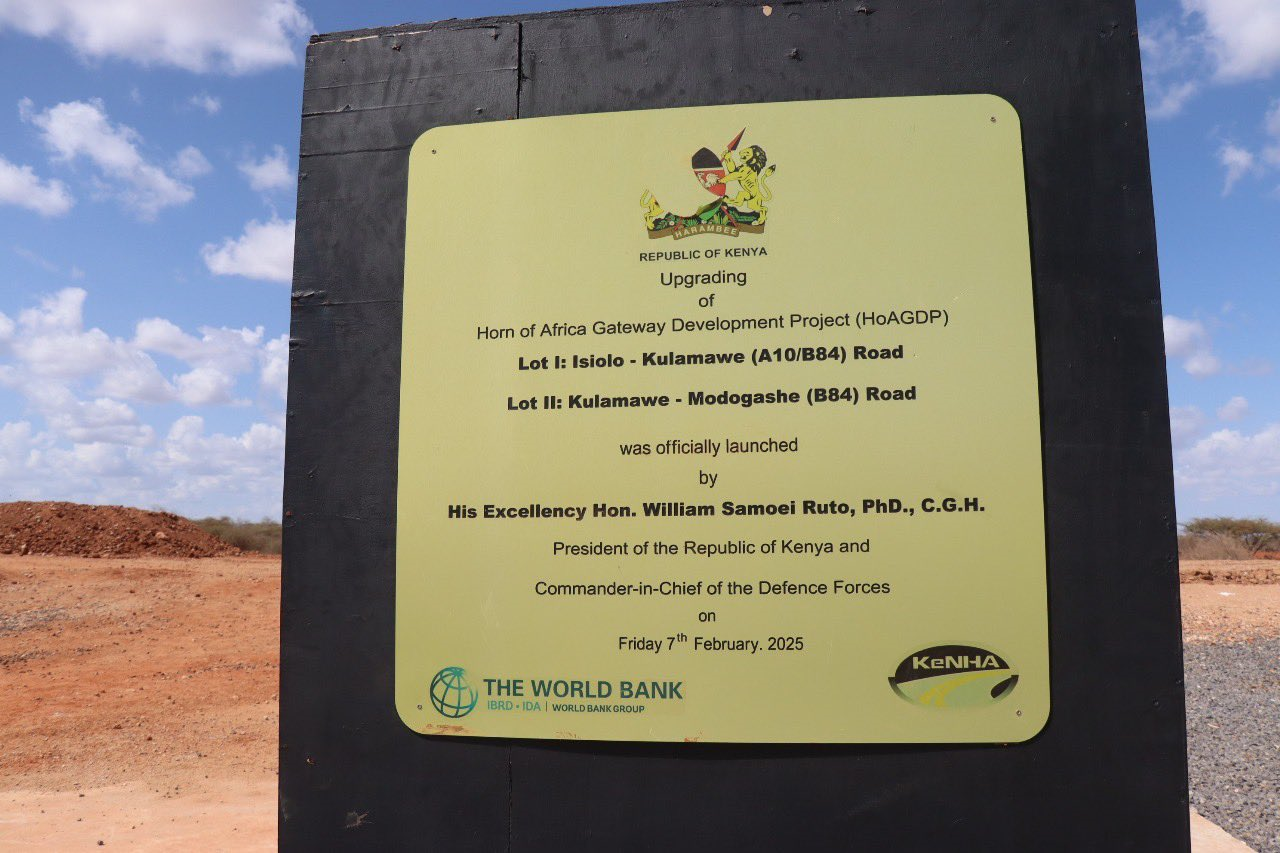
In the arid expanses of northern Kenya, the Modogashe road corridor, a critical link in the 740-kilometer Isiolo–Mandera highway, continues to illustrate a hard economic truth that the World Bank has repeatedly flagged in its project documents: prolonged periods without contractors on site drive up costs through price adjustments, interest on delayed payments, time extensions, and the need for remobilization.
What was designed as a transformational investment under the Horn of Africa Gateway Development Project (HoAGDP) is now grappling with the very cost escalations the Bank anticipated when works stalled.
What the World Bank Has Said
World Bank project papers and Implementation Status Reports paint a clear picture. The original US$750 million IDA credit, approved in 2020, has required substantial additional financing precisely because of cost overruns. According to Bank documents, these overruns stem from three main sources: technical design changes to make roads and bridges more climate-resilient (including raising embankments and improving drainage), sharp increases in construction material prices since the 2020 appraisal, and — crucially — payment delays that forced contractors to suspend works.
One key Bank assessment states that “delayed exchequer releases and insufficient budget have led to payment delays to contractors; some contractors suspended works for extended periods, resulting in time extensions, interest on delayed payments, and substantial increases in price adjustments.”
In response, the World Bank Board approved additional financing packages in 2026 — part of a broader US$550 million support that includes funds for the parent project and a second phase — specifically to cover these overruns and to bring the previously government-financed Modogashe–Samatar (67 km) and Rhamu–Mandera (76 km) sections fully under Bank-supported implementation. Bank documents note that the Government of Kenya had faced fiscal constraints mobilising its own share for these 143 kilometres and requested World Bank support to complete them.
The Bank’s revised economic analysis still shows strong returns, with an Economic Internal Rate of Return of around 25 per cent for the core World Bank-financed sections and a Net Present Value in the hundreds of millions of dollars. However, the documents make plain that every delay erodes part of that value by pushing completion further out and inflating the final price tag.
Progress and Persistent Gaps
On the ground, the Isiolo–Kulamawe–Modogashe sections (approximately 190 km) have advanced to around 45 per cent completion in recent Bank and government updates, with full completion targeted for 2027. Construction resumed more broadly across contracts in mid-2025 after suspensions were lifted and outstanding bills settled. Yet advocacy groups in Wajir continue to sound the alarm that the Modogashe–Samatar stretch risks further delays if financing and contractor presence are not sustained.
Local voices, including the Trans Wajir Advocacy Network, have warned that unresolved funding issues could lead to indefinite suspension of critical sections. Their concern aligns with the Bank’s own analysis: idle sites do not stay cost-neutral. Machinery must be demobilised and later remobilised, skilled labour disperses, materials become more expensive, and contractual claims for idle time and price variation accumulate.
The Human Cost Behind the Numbers
For communities along the corridor, the consequences are immediate. Longer travel times mean higher transport costs for livestock and goods, delayed access to healthcare and education, and fewer construction jobs for local youth. The World Bank has consistently described the project as more than a road — a “social and economic lifeline for pastoralist communities” that will improve movement of people and goods, expand digital connectivity through fibre-optic cables, and strengthen regional trade links with Ethiopia and Somalia.
That promise remains intact, but the meter is running. Every month contractors are not fully mobilised on the remaining sections adds to the final cost that Kenyan taxpayers and development partners will ultimately bear.
A Clear Message from the Financier
The World Bank’s documentation leaves little ambiguity. Cost overruns caused by prolonged inactivity are not theoretical — they have already materialised and required hundreds of millions of dollars in additional financing. The Bank has responded by deepening its commitment, but the underlying lesson is unchanged: sustained presence of contractors on site is the most effective way to protect both the development impact and the public purse.
As national authorities clear pending bills and push for accelerated delivery across the road sector, the Modogashe corridor stands as a live test case. The World Bank has quantified the price of delay. The question now is whether contractors will remain on site long enough to stop the cost clock from ticking further.