
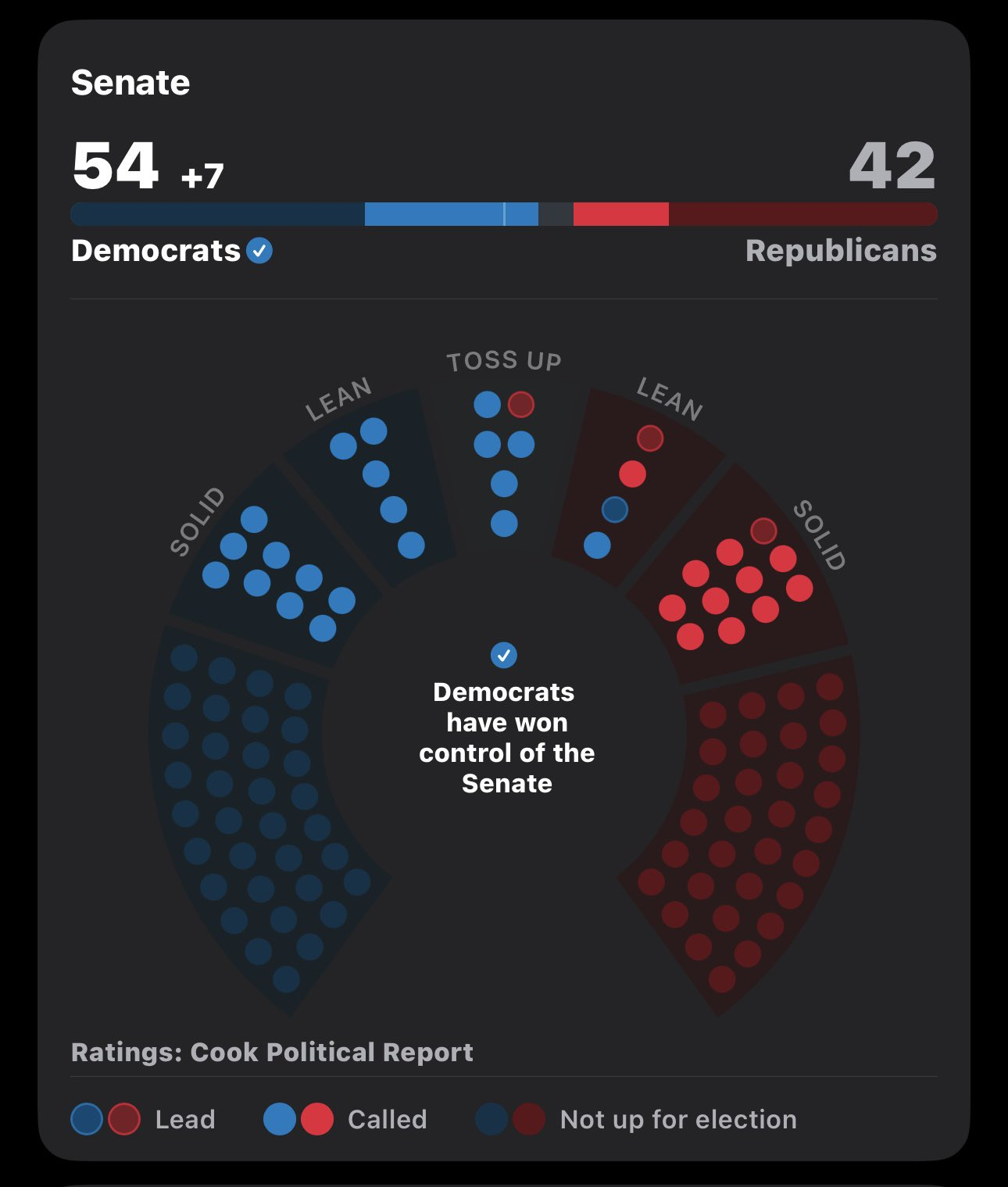
On a night that shattered long-held political assumptions, Democrats flipped control of both the U.S. House and Senate. Voters in deep-red strongholds delivered a stinging verdict on President Donald Trump’s second term, driven by frustration over the Iran war, soaring gas and grocery prices, and perceptions of Republican leadership priorities. Reuters Responsiblestatecraft
The most symbolic victory came in Kansas. Methodist megachurch pastor Adam Hamilton, a moderate who had previously been registered as a Republican, defeated incumbent Sen. Roger Marshall. Hamilton’s win ended a Democratic drought dating to 1932—the longest such streak for any state—and marked one of several improbable Senate flips. With most votes counted, Hamilton led roughly 52% to 45%. He built a coalition that included former Republican governors and appealed to independents and rural voters hit hard by rising diesel and beef costs tied to the conflict and tariffs. WSJ NBC News
Similar upsets unfolded elsewhere. In Texas, James Talarico defeated Ken Paxton for a Senate seat in the nation’s largest Republican state, while Democrat Gina Hinojosa ousted three-term Gov. Greg Abbott. Sherrod Brown flipped Ohio’s seat, Roy Cooper took an open North Carolina seat, Annie Andrews upset Darline Graham in South Carolina, and Josh Turek defeated Ashley Hinson in Iowa. These gains, part of at least seven Senate flips, handed Democrats majority control of the chamber. In the House, Democrats flipped more than two dozen seats, securing a clear majority after running the table in competitive races and holding most seats targeted by Republican redistricting efforts. PBS Newyorker
Exit polls and pre-election surveys pointed consistently to the same drivers: the unpopular Iran war (with large majorities calling the use of force the wrong decision), elevated costs of living, and broader dissatisfaction with Trump’s stewardship. Trump’s approval sat in the mid-to-high 30s among voters—among the lowest for a sitting president on Election Day in recent decades. Democrats campaigned on affordability, ending the war’s economic drag, healthcare, and accountability for the administration. Responsiblestatecraft NBC News
In the aftermath, Speaker Emerita Nancy Pelosi publicly nodded to the new leadership. In a statement, she congratulated Hakeem Jeffries as the incoming Speaker, praising his role in the victory and noting that he will become the first Black Speaker of the House—exactly twenty years after she became the first woman to hold the gavel. She framed the results as restoring a constitutional check on the presidency and a mandate to lower costs, protect Social Security and Medicare, and hold the administration accountable. Pelosi. house
Sen. Bernie Sanders, who had campaigned aggressively for progressive candidates on a “Fighting Oligarchy” message, saw a dual path forward. He had argued throughout the cycle that voters needed both to end Republican control of Congress—to check what he called an extraordinarily dangerous and corrupt administration—and to advance an agenda focused on working families rather than the wealthy. With majorities in hand, he and allies now have the tools to pursue investigations, legislative pushback on war funding and tariffs, and measures aimed at healthcare, wages, and inequality. Tradingview Thenation
On the Republican side, finger-pointing began even before final results. Operatives and some lawmakers blamed weak candidates in key races, complacency in once-safe seats, messaging failures, and—most persistently—the political costs of the Iran war, tariffs, and stalled or insufficient legislative deliverables on issues voters felt in their daily lives. Trump himself downplayed personal responsibility, attributing losses to candidates who failed to inspire turnout and noting he was not on the ballot. The result leaves him facing a fully divided Congress for the final two years of his term, with Democrats poised to use the House for oversight and the Senate to block major priorities. CNN CNN
The 2026 midterms stand as a rare double flip of both chambers and a map that stretched deep into territory Republicans had treated as secure. For Democrats, the night delivered power and a mandate centered on costs, the war’s fallout, and accountability. For Republicans, it opened an internal reckoning over strategy, candidates, and the political price of recent national priorities. The new Congress will test how both parties navigate the consequences.