
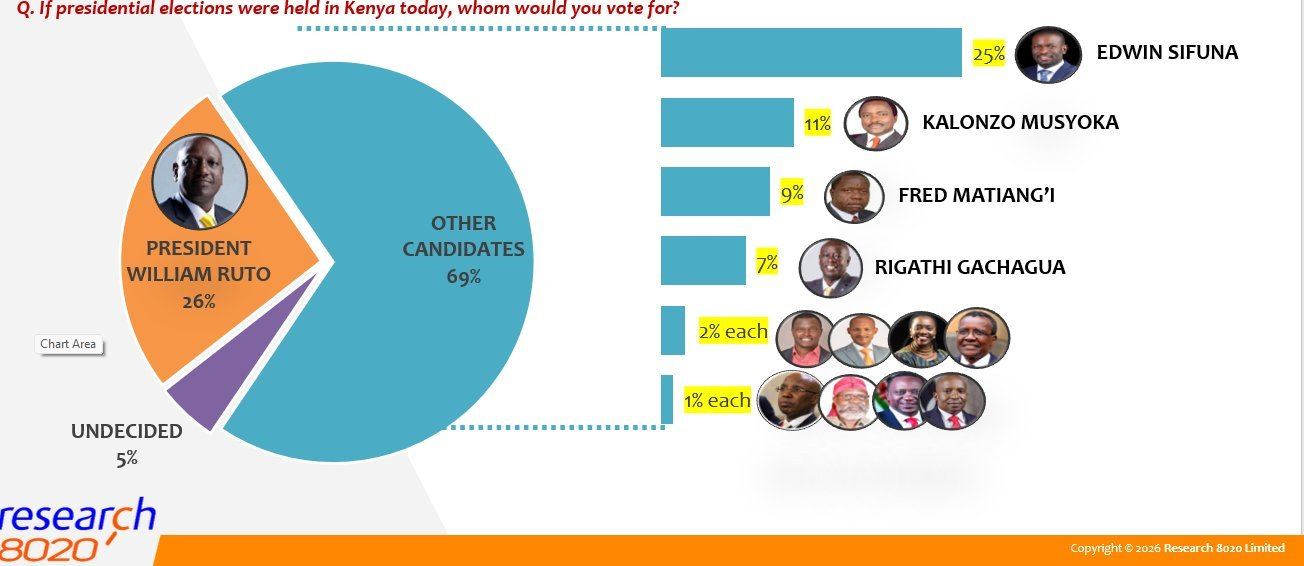
A new Research 8020 survey has found that only 26 percent of Kenyans currently support President William Ruto, while 69 percent say they would prefer an alternative candidate. Within that opposition space, Nairobi Senator Edwin Sifuna is emerging as a leading fresh voice, positioning himself as a carrier of the late Raila Odinga’s political legacy through his Linda Mwananchi Movement.
The survey results highlight deep dissatisfaction with the current administration and growing openness to new opposition leadership. Sifuna’s rallies have been drawing large crowds, with supporters viewing him as a younger, energetic figure capable of uniting those who once backed Odinga. His messaging has emphasized continuity with the late leader’s grassroots approach while presenting himself as an alternative to both the ruling party and older opposition structures.
However, Sifuna’s rising profile has also brought challenges. On October 23, one of his supporters, Anne Sitati, was attacked by a Ford Kenya aspirant. The incident has sparked demands for the attacker’s arrest and broader condemnation of political violence, with Sifuna’s allies warning that such acts risk undermining peaceful political competition.
Critics have raised concerns about the potential impact of Sifuna’s candidacy on regional voting blocs. Central Organisation of Trade Unions (COTU) Secretary-General Francis Atwoli has cautioned that Sifuna could split Luhya votes, a key constituency in Kenyan politics, and urged careful management of opposition unity ahead of future elections.
Other polling appears to reinforce Sifuna’s momentum. A separate Politrack survey found him leading among opposition figures with 19.6 percent support, placing him ahead of other potential challengers. Analysts say the combination of the Research 8020 findings and the Politrack numbers suggests Sifuna is consolidating attention as a primary alternative to the incumbent, even as questions remain about his ability to build a broad national coalition and navigate internal opposition rivalries.
With the next general election still months away, the current surveys and on-the-ground activity indicate an early but significant realignment. Sifuna’s ability to sustain large rally turnouts, respond to incidents such as the attack on Anne Sitati, and address warnings about vote-splitting will likely shape whether he can convert early poll strength into a durable challenge to President Ruto.