
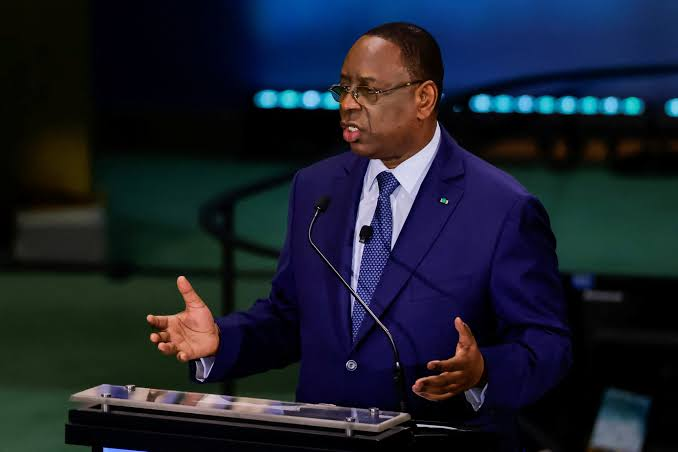
Dakar / New York / Marrakech, October 17, 2026 — Former Senegalese President Macky Sall announced today that he is withdrawing his candidacy for the position of United Nations Secretary-General, citing the outcome of an informal Security Council straw poll held the previous day and the emerging consensus that the next UN chief is likely to come from the Latin America and Caribbean region—possibly a woman.
Sall explains his withdrawal
In a statement released from Marrakech and posted on his social media accounts, Sall said he made the decision “with a deep sense of responsibility” after consultations with Burundian President Evariste Ndayishimiye, current Chairperson of the African Union, and Senegalese President Bassirou Diomaye Diakhar Faye, current Chairperson of ECOWAS.
Both leaders had supported his bid—Ndayishimiye as the nominating authority and Faye after Senegal formally endorsed Sall in July following an earlier period of hesitation.
“The results of the various test votes since the beginning of the process indicate a preference for a candidacy from the Latin American and Caribbean region, and possibly a woman,” Sall stated. He added that his goal was to contribute to the emergence of a consensus candidate within the Security Council.
His campaign and the regional rotation
Sall, who served as Senegal’s president from 2012 to 2024 and chaired the African Union in 2022–2023, was nominated by Burundi on March 2, 2026.
His campaign emphasized reforming multilateralism, linking peace with development, modernizing UN governance, and strengthening Africa’s voice in global institutions.
He faced an uphill battle from the outset due to the informal practice of regional rotation, which has favored a candidate from the Latin American and Caribbean Group (GRULAC) to succeed António Guterres, whose second term ends on December 31, 2026.
Security Council straw polls
Recent Security Council straw polls have shown stronger support for candidates from that region, including Costa Rica’s Rebeca Grynspan (former UNCTAD Secretary-General and Vice President) and Guyana’s Carolyn Rodrigues-Birkett (former foreign minister and current UN ambassador).
Argentine Rafael Grossi, head of the International Atomic Energy Agency, has also remained competitive. Reports following the October 16 informal vote indicated that all current candidates, including Sall, received opposing votes from at least some of the five permanent members of the Security Council.
Calls for UN reform and Africa’s voice
Sall thanked Ndayishimiye and Faye for their support, as well as Security Council members who voted in his favor, his campaign team, religious and traditional authorities, and Senegalese supporters at home and abroad.
Despite withdrawing, he reaffirmed his commitment to the ideals that motivated his candidacy: peace, security, economic and social development, international cooperation, and dialogue among nations.
He also reiterated his call for a “profound transformation” of the United Nations’ working methods and functioning amid multiplying conflicts, intensifying geopolitical rivalries, and unprecedented economic challenges.
“Africa, which is at the heart of the issues of peace, security and development, must also continue to make its voice heard and pursue its efforts to occupy its rightful place in global governance,” he wrote.
Sall concluded by wishing “full success to the person who will be called upon to exercise the high responsibilities of Secretary-General of the United Nations.”
Next steps in the UN selection process
The Security Council is expected to continue consultations and further straw polls in the coming weeks before recommending a candidate to the General Assembly for formal appointment. The next Secretary-General is scheduled to take office on January 1, 2027.
This story draws on Sall’s official statement and contemporary reporting from Senegalese and international outlets covering the UN selection process.