
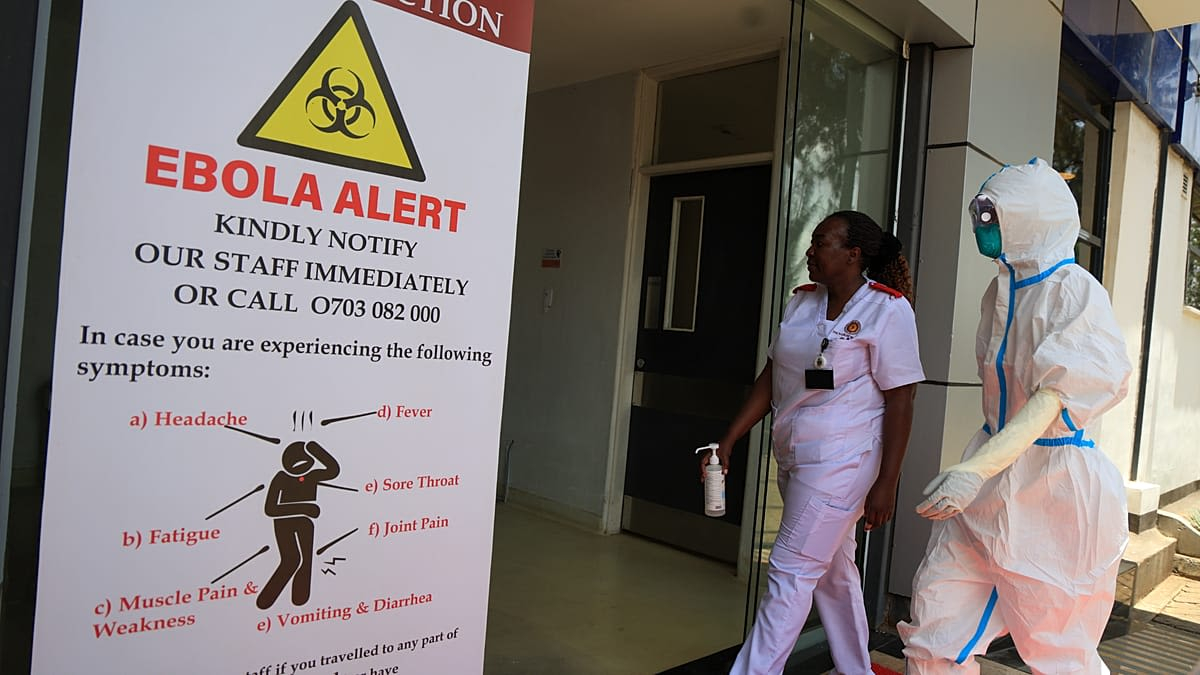
Kenya’s Ministry of Health confirmed four new cases of Ebola Bundibugyo virus disease on Saturday, raising the country’s total to seven, including the first patient who died earlier this month.
Four new cases detected in quarantine
The newly confirmed cases consist of a close male relative of the deceased index patient and three health workers who treated him in hospital. The relative had been under quarantine since October 6.
The health workers—two men aged 29 and 35 and a 32-year-old woman—cared for the index case on October 3 and 4 and had been in quarantine since October 9.
All four developed fever while already in quarantine, were immediately isolated, and tested positive at both the National Virology Reference Laboratory and the Kenya Medical Research Institute (KEMRI).
Earlier cases linked to the index patient
These mark the first known infections transmitted inside Kenya. The index patient, a 40-year-old Kenyan man, arrived in Nairobi by air from the Democratic Republic of Congo (DRC) on October 3 after traveling overland through Uganda.
He was taken to hospital by a relative and died on October 5. Earlier confirmed cases included a 39-year-old male relative and a 65-year-old female relative of the index patient; both remain stable and are responding well to supportive care.
Contact tracing and the Ministry’s risk assessment
Health authorities stated that the four new patients are receiving supportive treatment at a designated facility. There is no evidence of community transmission, and the risk to the general public remains low, the Ministry said.
Of 130 identified contacts linked to the index case, 128 (98.5 percent) have been traced and placed in quarantine—well above the 85 percent global benchmark typically required to interrupt transmission chains.
Officials noted that additional cases among quarantined contacts remain possible until the 21-day monitoring period ends, but early detection has limited further spread so far.
Link to the Bundibugyo Ebola outbreak in the DRC
Kenya’s cases are linked to a large ongoing outbreak of Bundibugyo Ebola in the DRC that began in May 2026. That epidemic has recorded more than 9,000 cases and more than 4,000 deaths, making it one of the largest on record.
Bundibugyo is a rare strain of the virus for which no approved vaccine or specific antiviral treatment currently exists.
Ebola spreads through direct contact with the bodily fluids of infected people (living or deceased) or with contaminated materials such as bedding or clothing; it is not airborne.
Screening and public-health response
Kenyan authorities have intensified screening at airports and border points, distributed protective equipment, and established an emergency hotline.
The Ministry has urged the public to remain vigilant, report any potential exposures or symptoms promptly, and continue normal activities, emphasizing that Kenya remains open with no restrictions on travel, trade, or public gatherings.
Contact-tracing and quarantine efforts continue, and health officials say they will provide further updates as the situation evolves.