
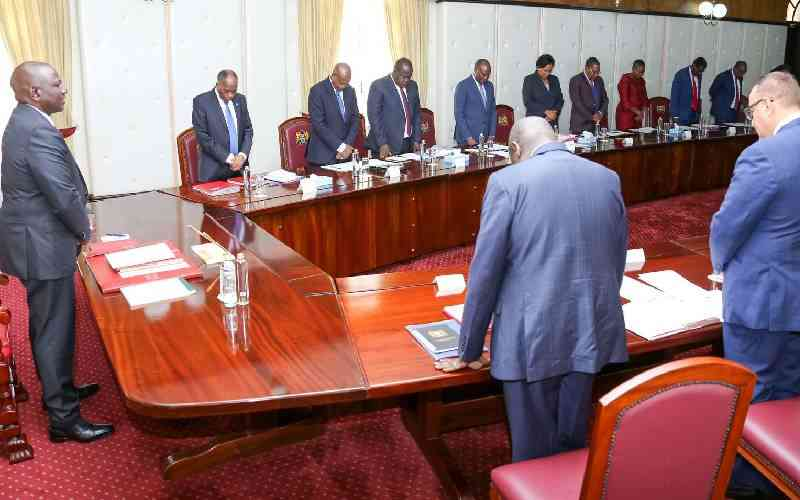
NAIROBI, KENYA — In a political and legal development that threatens to trigger a profound constitutional crisis, Busia Senator Okiya Omtatah has moved to the High Court seeking to strip President William Ruto’s entire Cabinet of its executive mandates. The petition argues that Kenya’s current National Executive is unconstitutionally constituted following the expiration of a critical court deadline meant to address historical gender imbalances within the top echelons of government. [1, 2, 3]
The constitutional reference, filed jointly by Omtatah, Eliud Karanja Matindi, and Dr. Magare Gikenyi Benjamin, has thrown the operations of the state into uncertainty. It demands conservatory orders that would effectively paralyze the administration, halting Cabinet Secretaries from executing official policies, signing state documents, or drawing public salaries. [1, 2]
The Genesis of the Crisis
At the core of the petition lies a lingering legal battle over Article 27(8) of the Constitution of Kenya, which stipulates that not more than two-thirds of the members of elective or appointive bodies shall be of the same gender.
On June 30, 2026, the High Court delivered a landmark ruling declaring that President William Ruto’s Cabinet failed to satisfy this mandatory constitutional threshold. Recognizing the immense administrative chaos an immediate dissolution would cause, the court granted the Executive a grace period of 120 days to reconstitute the Cabinet and bring it into strict compliance with the two-thirds gender rule. [1]
According to the petitioners, that 120-day window officially lapsed on October 28, 2026. Because the Head of State did not reorganize his Cabinet or replace sitting male ministers to achieve the requisite gender balance before the expiration of the timeline, Omtatah argues that the entire executive body has lost its legitimacy and constitutional validity. [1, 2, 3]
“An Illegal Executive Body”
In their court submissions, the petitioners present a stark interpretation of the law: when a deadline set by a constitutional court expires without compliance, the affected entity automatically becomes a legal nullity.
“Kenya has no constitutionally constituted National Executive,” Omtatah asserts in the petition. The legal team representing the petitioners maintains that allowing the current Cabinet Secretaries to continue running ministries, attending Cabinet sessions, and making policy decisions is a direct violation of the rule of law and an insult to the authority of the Judiciary. [1, 2, 3]
The petition names 25 high-profile respondents, representing the entire apex of the executive branch. This includes President William Ruto, Deputy President Kithure Kindiki, the Attorney-General, and all 22 Cabinet Secretaries currently serving in the administration.
Sweeping Demands and Financial Sanctions
Omtatah and his co-petitioners are not merely seeking a symbolic statement from the courts; they are pushing for sweeping operational and financial sanctions against the government officials. The petition seeks several prayers from the High Court:
- Conservatory Orders: An immediate injunction restraining all 22 Cabinet Secretaries from performing any official state duties, attending Cabinet meetings, or representing themselves as lawful ministers of the Republic of Kenya. [1]
- Freezing of Salaries and Benefits: An order directed at the Controller of Budget and the National Treasury to immediately freeze the disbursement of public funds intended for the salaries, allowances, and benefits of the affected Cabinet Secretaries.
- Invalidation of Decisions: A declaration that any and all official actions, executive orders, bilateral agreements, and policy directives authorized by the Cabinet after the October 28, 2026 deadline are null and void.
- Surcharge of Public Funds: A demand that the ministers be ordered to personally refund all public remuneration and benefits received since the expiration of the 120-day compliance window.
If granted, these prayers would effectively bring the executive arm of the Kenyan government to a grinding halt, locking out ministers from their offices and putting a stop to major state projects and ministerial functions.
High Court Rejects Urgent Freeze, Sets Timeline
The petition was placed before High Court Judge Patricia Nyaundi on November 5, 2026. While the petitioners urged the court to issue immediate, temporary conservatory orders to halt Cabinet operations due to the urgency of the alleged constitutional breach, Justice Nyaundi opted for a more measured approach.
The judge declined to grant ex-parte interim orders or certify the matter as an instantaneous emergency that overrides due process. Instead, Justice Nyaundi directed the petitioners to formally serve the petition and all accompanying legal documents to all 25 respondents by November 9, 2026.
The court has granted the President, the Deputy President, the Attorney-General, and the Cabinet Secretaries until November 24, 2026, to file their formal responses and counter-arguments. The matter will then return to the court for further directions on how the main suit will be heard and determined.
Political and Constitutional Implications
This legal challenge marks yet another chapter in Okiya Omtatah’s long history of public interest litigation, but its stakes are arguably among the highest seen in recent years. By directly targeting the legality of the entire Cabinet, the case exposes a structural vulnerability in how the executive branch balances political alliances with rigid constitutional quotas.
Legal analysts are divided on how the High Court might rule. Some argue that constitutional timelines must be strictly protected to prevent the Executive from ignoring judicial oversight. They point out that the two-thirds gender rule has been a thorny issue since the promulgation of the 2010 Constitution, and subsequent administrations have repeatedly failed to enforce it fully. A strict ruling from the court could finally force a political reckoning regarding gender equity in leadership.
On the other hand, defenders of the administration argue that a literal interpretation leading to the immediate shutdown of the Cabinet could trigger a governance failure. They emphasize that state continuity, national security, and economic stability rely heavily on the continuous operation of ministries. The state’s defense is expected to argue that public interest favors keeping the government running while adjustments to the Cabinet are organized behind the scenes.
As the November 24 deadline for responses approaches, all eyes remain on the High Court. Kenya finds itself waiting to see whether a judicial order will compel President Ruto to completely overhaul his Cabinet, or if the executive branch can find a legal avenue to navigate out of this gender-rule deadlock.