

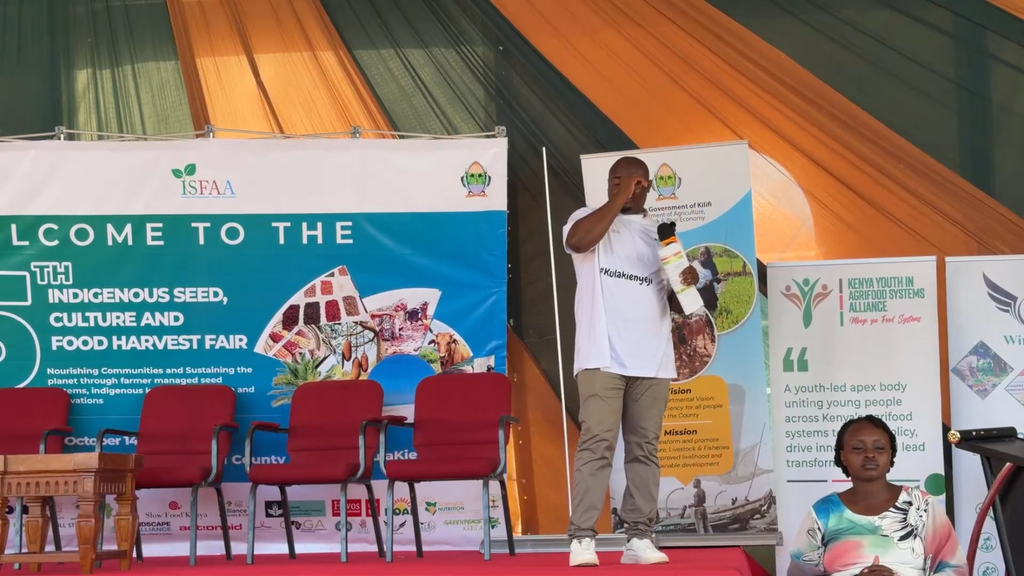
In the coastal heartland of Kilifi, Kenya, a vibrant gathering brought together agricultural advocates, government leaders, cultural custodians, and smallholder farmers to confront one of the most vital issues facing African agriculture today: seed sovereignty, indigenous farmer rights, and the building of climate-resilient food systems. The event organized alongside grassroots partners including the Seed Savers Network Kenya (SSN)—highlighted the deep intersection of traditional ecological knowledge, constitutional rights, and modern agricultural policy reform.
Held against the backdrop of shifting weather patterns and rising food insecurity across East Africa, the event opened with a spirited celebration of indigenous heritage. Participants were welcomed by cultural performances from the Rabai community of Kilifi and delegations from West Pokot, Homa Bay, and across Kenya. The local rallying cry, “Kilifi Kula Kienyeji” (“Kilifi, Eat Traditional Food”), echoed throughout the day, calling on communities to embrace indigenous tubers, wild Yams, sorghum, millet, and leafy vegetables that have sustained generations without chemical dependency.
High-Level Engagement and Cultural Heritage
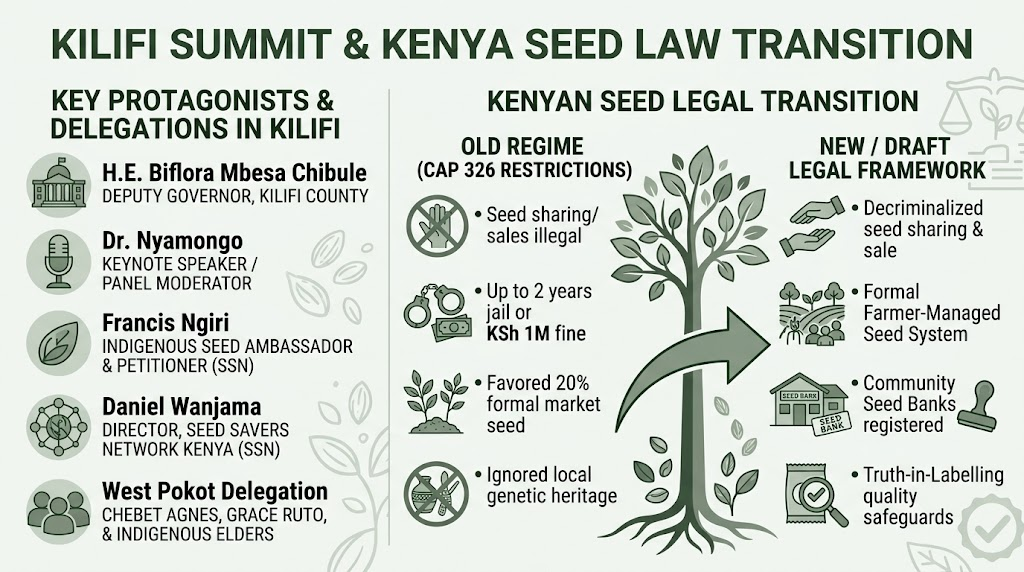
The summit was graced by Her Excellency Biflora Mbesa Chibule, Deputy Governor of Kilifi County, who reaffirmed the local government’s commitment to prioritizing traditional nutrition and supporting smallholder farmers. Her presence underscored the crucial role county governments play in bridging national legislation with local community implementation.
Culturally diverse delegations shared testimony after testimony regarding the health and longevity benefits of traditional foods. Elders and women farmers from West Pokot showcased traditional climbing yams (Aerial Yams) and indigenous medicinal herbs. Speaking on behalf of the West Pokot delegation, Grace Ruto and Chebet Agnes emphasized how returning to organic, native crops promotes health and resilience among older generations, citing examples of elders thriving well into their 80s and 90s on traditional diets.

Global and National Seed Governance: From Rio to Nairobi
The focal point of the summit was an expert panel discussion entitled “Governing Indigenous Seeds, Farmers’ Rights, and Resilient Food Systems,” moderated by agricultural expert Dr. Nyamongo. Dr. Nyamongo provided an overarching historical narrative explaining how global biodiversity governance evolved:
- 1992 Rio Convention on Biological Diversity (CBD): Established sovereign national rights over biological diversity and genetic resources.
- 2004 FAO International Treaty on Plant Genetic Resources for Food and Agriculture (ITPGRFA): Recognizing that food security depends on international crop interdependence, this treaty established a multilateral system to facilitate access and benefit-sharing for key staples (Annex 1 crops like maize, sorghum, cassava, and potatoes).
- 2010 Nagoya Protocol: Established specific binding legal frameworks for Fair and Equitable Benefit-Sharing arising from the utilization of genetic resources.
At the continental level, Dr. Nyamongo noted recent progress by the African Union, including member states meeting in Eswatini to adopt the Farmer-Managed Seed System (FMSS) Framework. This milestone recommends that African heads of state formally recognize smallholder seed systems alongside formal commercial frameworks.
The Historic Landmark Judgment: Decriminalizing Seed Sharing
In Kenya, smallholder farmers have long struggled under restrictive laws. Section 3D(1) and related provisions of Kenya’s Seeds and Plant Varieties Act (Cap 326) previously criminalized the uncertified sale, exchange, or sharing of traditional seeds, imposing penalties of up to two years’ imprisonment or severe fines up to KSh 1,000,000.
Panelist Francis Ngiri, an indigenous seed ambassador and smallholder farmer, recounted his experience as one of 15 lead petitioners from the Seed Savers Network who challenged the constitutionality of Cap 326 in the High Court:
“Exchanging seeds is part of our cultural DNA and African tradition. The law threatened to jail farmers for simply passing on resilient seeds handed down by our ancestors. We went to court to assert our constitutional right to food security and genetic heritage under Article 11(3)(b) of the Constitution of Kenya.”
In a landmark legal victory for smallholders, the High Court ruled in favor of the farmers, declaring provisions that criminalize seed sharing and selling among farmers unconstitutional. The judgment affirmed that farmer-managed seed systems directly fulfill constitutional protections regarding food access, livelihoods, and cultural rights.
Institutionalizing Farmer-Managed Seed Systems (FMSS)
While the court ruling provided immediate relief, long-term sustainability requires institutional policy reform. Daniel Wanjama, Director of Seed Savers Network Kenya, outlined how public interest organizations have been collaborating with the Ministry of Agriculture to revise the National Seed Policy, Seed Bill, and accompanying Regulations:
- Formal Anchoring of FMSS: The new draft policy explicitly recognizes Farmer-Managed Seed Systems alongside commercial seed companies, allowing smallholders to legally conserve, package, exchange, and sell indigenous seeds.
- Establishment of Community Seed Banks: The policy provides a registration pathway for Community Seed Banks managed at the county level. On the sidelines of the summit, stakeholders celebrated the launch of a new community seed bank in Kilifi County to safeguard local genetic stock.
- Equitable Benefit Sharing: The legislation establishes mechanisms to ensure that when private seed breeders or commercial entities utilize community genetic resources to develop commercial hybrids, the local communities who preserved those seeds receive fair compensation—such as local infrastructure development or royalties.
- Pragmatic Quality Control (“Truth-in-Labelling”): To address corporate concerns about plant disease transmission without burdening poor farmers with prohibitive certification costs, the new framework introduces Truth-in-Labelling rules. Farmers package and honestly disclose crop variety details, holding sellers accountable under general consumer protection standards without forcing smallholders through complex corporate certification processes.
Looking Ahead: Achieving True Food Sovereignty
The gathering in Kilifi demonstrated that African food systems stand at a pivotal turning point. Commercial seed systems currently supply only 20% of total seed demand across Sub-Saharan Africa, while informal, farmer-managed systems account for 80%.
By enshrining smallholder rights into law, protecting indigenous biodiversity, and building community-led seed banks, Kenya is establishing a model for agroecological resilience across the continent. As the Draft Seed Bill moves through public participation, speakers urged farmers and civil society to stay vigilant, ensuring these constitutional protections remain intact for generations to come.
Key Information Summary
| Aspect | Summary Details |
| Event / Stream | Kilifi Indigenous Seed & Agroecology Summit |
| Video Link | Watch on YouTube |
| Key Leaders | H.E. Biflora Mbesa Chibule (Deputy Governor, Kilifi), Dr. Nyamongo, Francis Ngiri, Daniel Wanjama |
| Primary Theme | Farmer-Managed Seed Systems (FMSS), Indigenous Rights, and Biodiversity Governance |
| Legal Victory | High Court judgment declaring the criminalization of farmer seed sharing unconstitutional |
| Policy Future | Draft National Seed Policy and Draft Seed Bill enacting Community Seed Banks and Truth-in-Labelling |