
Narok – November 14, 2026
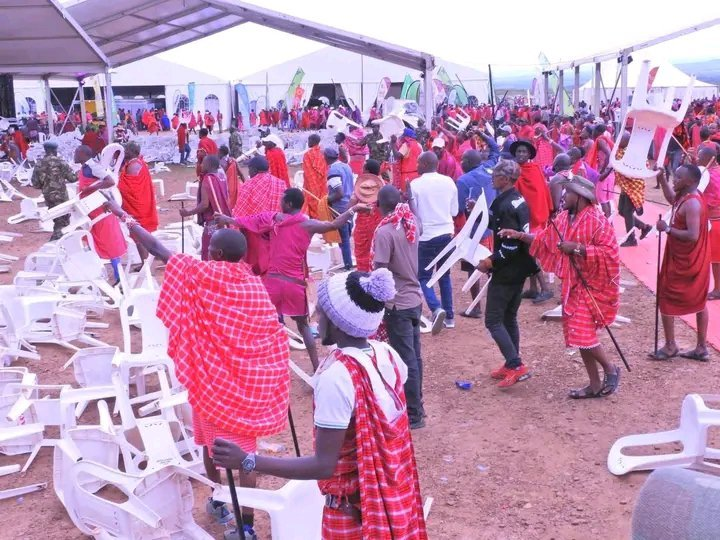
A decades-old land dispute over the 4,700-acre Olkiombo parcel in the Maasai Mara ecosystem boiled over into open confrontation on Saturday, disrupting the closing of the fourth Maa Cultural and Tourism Festival at Sekenani Gate as President William Ruto attended the event.
Rival groups clashed near the venue, throwing chairs and sending attendees scrambling for safety. Videos circulating online showed disorder near the dais, with scattered and overturned seats. Security officers from the Presidential Escort Unit and General Service Unit quickly formed a cordon around the President as the situation unfolded. Reports linked the groups to supporters of Narok Governor Patrick Ole Ntutu and Narok West MP Gabriel Tongoyo. Some accounts also referenced tensions over Olkiombo-branded items amid earlier warnings of confrontation.
The incident temporarily interrupted the cultural gathering, which had drawn thousands of Maa-speaking people from Narok, Kajiado, Samburu and beyond to celebrate heritage under the theme of promoting cultural expressions for socio-economic development.
How the Dispute Began
The roots of the Olkiombo conflict stretch back more than 40 years. In 1984, land was excised from the Maasai Mara National Reserve through a gazette notice. A company linked to the Ntutu family, Ol Kiombo Ltd, later held a lease. By the early 1990s the lease arrangement changed, and the area was treated as part of the reserve again.
In 1997, Livingstone Kunini Ntutu (brother of Governor Patrick Ole Ntutu) obtained Title No. CIS-MARA/TALEK/155 for roughly 4,700 acres near Talek. Local communities and the then Narok County Council immediately challenged the allocation, arguing the land had never been properly surveyed or lawfully removed from the reserve and that the title was irregularly created after adjudication processes closed.
Kunini filed suit in 2000 seeking full ownership and control of revenue. A 2002 consent judgment initially favoured him, but later county leadership challenged it as entered without proper authority. In 2014 the High Court set aside the consent and ordered a full hearing on the title’s legality in the public interest. Appeals followed through the Court of Appeal and Supreme Court. In 2018 the Supreme Court directed the Environment and Land Court to determine the constitutionality and legality of the title afresh.
How Differences Deepened
The conflict intensified over successive court rulings, revenue claims running into billions of shillings from tourism activities, and accusations of political influence. Community members and activists insisted Olkiombo remains public or community land essential for conservation and local benefit within the Maasai Mara ecosystem. Kunini and his supporters maintained the title was valid.
In March 2025 the Environment and Land Court ruled in Kunini’s favour, sparking protests in which residents stormed the area. The Court of Appeal later set aside that judgment in May 2026 and ordered a fresh hearing. Interim orders at times allowed continued possession and revenue collection while barring sale or transfer.
Survey of Kenya officials have described the parcel as “foreign” to their records, with no supporting survey documentation. On 14 November 2026 itself, Lands Cabinet Secretary Alice Wahome told the National Assembly Lands Committee that the land was irregularly acquired because no survey existed before the certificate of ownership was issued.
Political family ties complicated perceptions. Governor Ntutu has stated the dispute is an individual claim by his brother and not a collective family or county matter, while critics have raised conflict-of-interest concerns. Local activists, including Dominic Kasoe, mobilised youth under slogans such as “Melo Olkiombo” (“Olkiombo will not be grabbed”), framing the issue as resistance to land grabbing.
Link to Today’s Chaos
Tensions around the festival had been building for weeks. Rival youth groups planned to attend wearing contrasting messages related to the land. One faction allied with land-rights campaigners prepared “Melo Olkiombo” T-shirts; another group linked to county interests issued warnings interpreted by residents and local leaders as threats of confrontation. Security agencies were urged to maintain order.
On the final day, with President Ruto present, those underlying rivalries erupted into physical clashes between groups reportedly aligned with the governor and the local MP. The long-running Olkiombo dispute—already a flashpoint for community grievances, conservation concerns and local politics—provided the combustible backdrop. What began as a cultural celebration of Maa identity was briefly overshadowed by the unresolved land battle that has simmered since the 1980s.
Elders and community members continue to call for the title’s revocation and the land’s return to public or community control. The fresh Court of Appeal process and the Lands Ministry’s recent statements keep the legal and administrative pathways open, but Saturday’s scenes at Sekenani demonstrated how deeply the dispute still divides the region.