
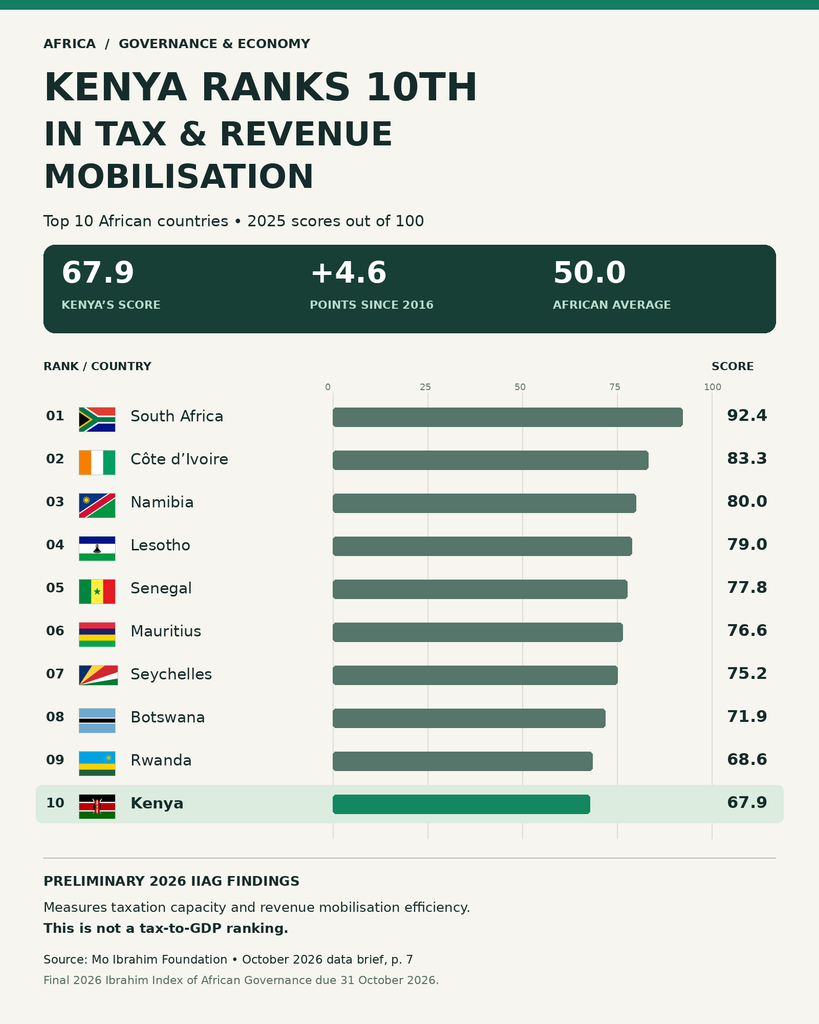
Kenya has ranked 10th out of 54 African countries on tax and revenue mobilisation, scoring 67.9 points in the preliminary findings of the 2026 Ibrahim Index of African Governance (IIAG).
The result places the country well above the continental average of 50.0 and in a small group of states whose performance has improved, and accelerated, over the past decade.
The ranking comes from a data brief released by the Mo Ibrahim Foundation in October 2026. The full 2026 IIAG is due to be launched in Cairo on 31 October.
The Tax & Revenue Mobilisation indicator is one of 96 measures in the index. It sits under Foundations for Economic Opportunity, in the Public Administration sub-category, and covers 2016 to 2025.
How the top 10 compare
South Africa leads by a wide margin. Kenya is last in the top ten, 24.5 points behind the leader.
| Rank | Country | 2025 score | 10-year change | Trend |
|---|---|---|---|---|
| 1 | South Africa | 92.4 | +2.2 | Slowing Improvement |
| 2 | Côte d’Ivoire | 83.3 | +13.9 | Increasing Improvement |
| 3 | Namibia | 80.0 | −1.1 | Bouncing Back |
| 4 | Lesotho | 79.0 | −3.9 | Increasing Deterioration |
| 5 | Senegal | 77.8 | −2.8 | Increasing Deterioration |
| 6 | Mauritius | 76.6 | +12.0 | Slowing Improvement |
| 7 | Seychelles | 75.2 | −8.1 | Bouncing Back |
| 8 | Botswana | 71.9 | +2.0 | Increasing Improvement |
| 9 | Rwanda | 68.6 | +4.9 | Increasing Improvement |
| 10 | Kenya | 67.9 | +4.6 | Increasing Improvement |
Kenya’s score has risen by 4.6 points since 2016. The foundation classifies that path as “Increasing Improvement,” meaning the 2025 score is higher than in 2016 and the pace of gains has quickened since 2021.
Rwanda, immediately ahead on 68.6, follows a similar trajectory, up 4.9 points over the decade. Côte d’Ivoire recorded the largest gain among the top ten, at 13.9 points.
At the other end of the table, Libya scores 2.8. The gap between the highest and lowest country is 89.6 points. Sudan, South Sudan, Equatorial Guinea and Eritrea also sit near the bottom.
What the indicator actually measures
The score is not a tax-to-GDP ratio. The foundation is explicit that the indicator does not track the share of GDP collected in tax, nor the mix of VAT, income tax and other heads.
It is built from two sub-indicators: Taxation Capacity, drawn from UNU-WIDER, and Efficiency of Revenue Mobilisation, drawn from the African Development Bank and the World Bank.
In short, it looks at the structure of the tax system and how effectively revenue is administered, not at how large the take is relative to the economy.
Kenya’s revenue collections and tax-to-GDP ratio
That distinction matters for Kenya. Collections have been rising in absolute terms.
The Kenya Revenue Authority reported Sh2.844 trillion in taxes and agency revenues in the 2025/26 financial year, up Sh272.95 billion, or 10.6 per cent, from Sh2.572 trillion the year before.
At the same time, the tax-to-GDP ratio has slipped to about 14.4 per cent, down from close to 18 per cent in 2013–14, according to the National Treasury.
The Medium-Term Revenue Strategy still aims to lift that ratio substantially, mainly by widening the base rather than raising rates.
A continent that is not moving together
At the African average, Tax & Revenue Mobilisation fell by 1.5 points between 2016 and 2025, ending at 50.0. Twenty-nine countries scored above that average and 25 below it.
Sixteen countries, including Kenya, Botswana and Rwanda, are on an “Increasing Improvement” path. Twelve are on “Increasing Deterioration.”
About 56 per cent of Africa’s population lives in a country where the indicator has declined over the decade.
East African Community posts a positive trend
The East African Community is the only one of the continent’s eight regional economic communities to post a positive average 10-year trend on this measure, up 2.7 points. Kenya and Rwanda both contribute to that regional picture.
The foundation argues that stronger revenue systems underpin macroeconomic stability, reduce dependence on volatile external finance and support sovereign credit ratings.
Africa’s average tax-to-GDP ratio has edged up for three consecutive years to around 15 per cent by 2023, still well below the OECD average of about 25 per cent. In 2022, only 17 African countries were above 15 per cent.
What the ranking does and does not settle
A 10th-place score of 67.9 is a relative strength. Kenya is above the continental average, improving faster than it was earlier in the decade, and close to Rwanda.
It is not evidence that the domestic revenue problem is solved. The gap to South Africa, whose score has stayed near 90 for the whole decade, remains large.
Absolute collections can rise while the tax take fails to keep pace with the economy, which is the pattern Treasury has flagged.
Digital tools such as eTIMS have been credited with simpler filing and higher compliance, but formal employment’s share of total employment has been shrinking, and large parts of agriculture and the informal economy remain lightly taxed.
Preliminary findings ahead of the final 2026 IIAG
The figures in the brief are preliminary. The foundation says the calculations have been checked internally but not yet vetted externally, and that the final 2026 IIAG will be published on 31 October 2026.