
Nairobi, November 23, 2026
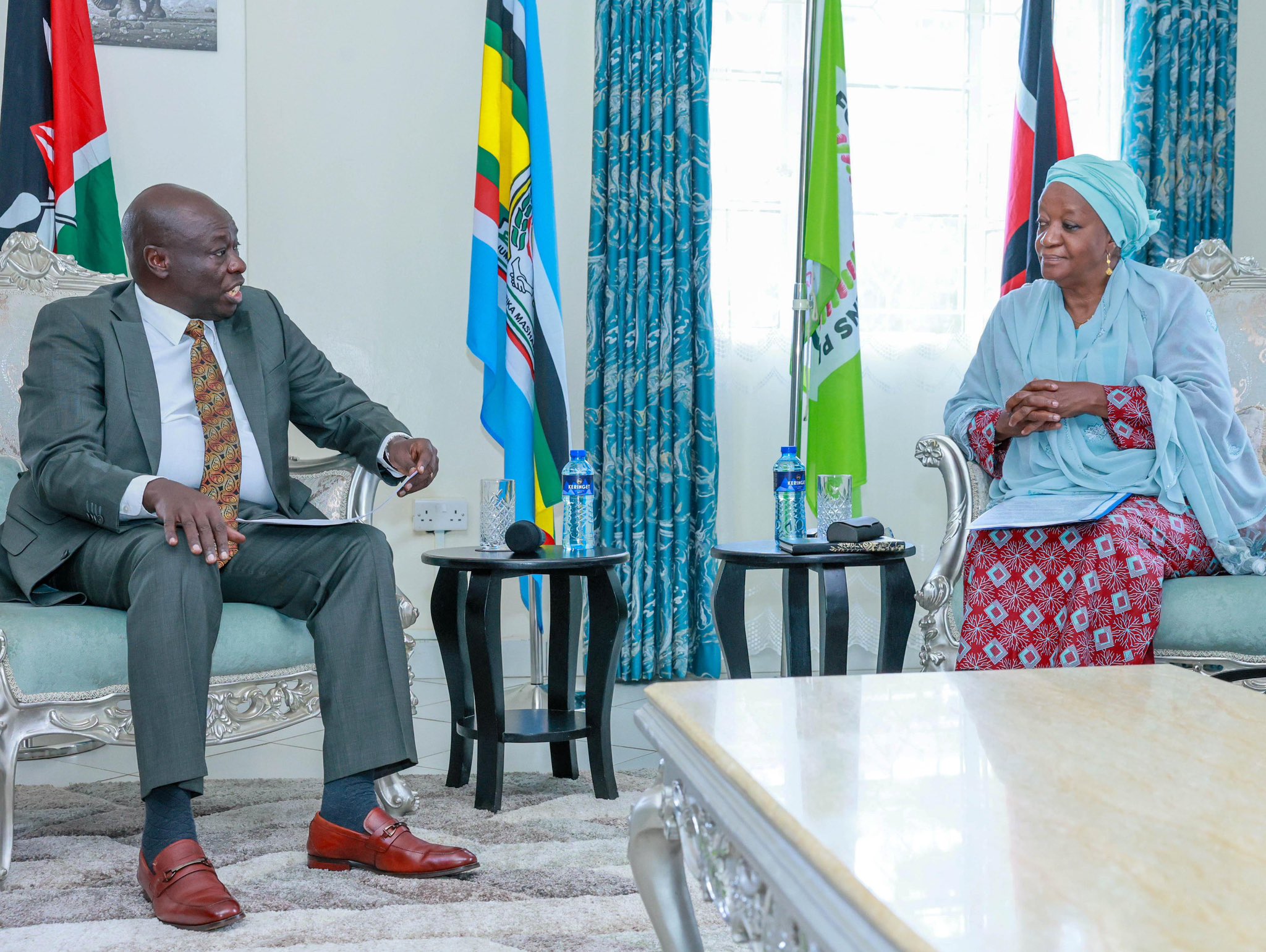
Former Deputy President Rigathi Gachagua on Monday hosted United Nations Office at Nairobi (UNON) Director-General Zainab Hawa Bangura for a courtesy call at his Nairobi office. During the meeting, the Democracy for the Citizens Party (DCP) leader pressed the senior UN official on alleged human rights violations, political violence, the activities of what he described as state-sponsored militias, and the perceived partisanship of the Independent Electoral and Boundaries Commission (IEBC) ahead of Kenya’s August 10, 2027, General Election.
Gachagua, who was impeached and removed as deputy president in 2024, has rebuilt his political platform through DCP. The party has been actively recruiting defectors from the ruling United Democratic Alliance (UDA), consolidating support in the Mount Kenya region, and preparing to contest seats nationwide, including a full slate in Nairobi. The Monday meeting forms part of a broader pattern of opposition engagement with domestic and international actors as political temperatures rise more than 20 months before the polls.
In a statement issued after the talks, Gachagua said the discussions centered on the country’s political environment. “We discussed critical issues concerning our country, Kenya, and, more specifically, the abuse and violation of human rights, political violence, and state-sponsored militias wreaking havoc countrywide, as well as the partisan nature of the Independent Electoral and Boundaries Commission (IEBC) ahead of the 10th August 2027 General Elections,” he stated.
Concerns Over Human Rights and Violence
Gachagua told Bangura that he was drawing the United Nations’ attention to what he called the “blatant abuse of human rights,” disregard for the rule of law, political violence, and “goonism.” He specifically highlighted extrajudicial killings, abductions, and attacks targeting young people, arguing that these developments threatened Kenya’s democratic values.
“We also urged the UN to implore the Government of Kenya to cease and desist from violence, extrajudicial killings, abductions, and brutal killings of our young people, and to respect human rights,” Gachagua said. He framed the protection of citizens, regardless of political affiliation, as essential to preventing a repeat of past cycles of pre-election, election, and post-election unrest.
Kenya has a well-documented history of election-related violence, most notably the post-2007 crisis that claimed more than 1,000 lives and displaced hundreds of thousands. Opposition figures have repeatedly warned that unresolved questions about electoral management, security force conduct, and political polarization could recreate conditions for instability in 2027.
IEBC Impartiality and Public Confidence
A significant portion of the discussion focused on the IEBC. Gachagua argued that the commission has lost public confidence and is perceived as aligned with the current administration.
“The IEBC, as it were, has lost the confidence of the people of Kenya, which is a precursor to suspected mischief in the forthcoming polls,” he said. “To address this, the IEBC must be objective, non-partisan, and willing to listen to all stakeholders in this election and not stay in bed with this regime.”
He called on the United Nations to urgently intervene by pressing the IEBC to engage all electoral stakeholders and address issues eroding public trust. These concerns follow recent opposition actions, including a walkout by Gachagua and other leaders from an IEBC consultative meeting on November 19, 2026, and Gachagua’s public ultimatum—issued the day before the UN meeting—giving the commission until January 2027 to address specific demands.
Those demands have included an independent audit of the voters’ register to remove deceased persons and allegedly irregularly registered voters, clarity on the procurement of a new election management system following the expiry of the current Smartmatic contract, and greater transparency in the transmission and tallying of results.
Broader Context and UN Engagement
Zainab Hawa Bangura, a Sierra Leonean diplomat and former UN Special Representative of the Secretary-General on Sexual Violence in Conflict, has served as Director-General of UNON (at Under-Secretary-General level) since 2020. UNON is one of the United Nations’ major global hubs, hosting numerous agencies and contributing substantially to Kenya’s economy. Bangura’s role includes representation and engagement with Kenyan authorities and stakeholders on issues affecting the UN’s presence and broader political and diplomatic matters in the region.
On the same day she met Gachagua, Bangura also held talks with Jubilee Party leader and former Interior Cabinet Secretary Fred Matiang’i. Matiang’i later said their discussion focused on safeguarding peace and stability ahead of the 2027 elections and on protecting Nairobi’s status as the only UN headquarters in Africa and the Global South.
No detailed public response from Bangura or UNON to the specific allegations raised by Gachagua has been reported. Reports of the meeting are based primarily on Gachagua’s own statement and accompanying photographs shared on social media.
The engagement occurs against a backdrop of intensifying political maneuvering. DCP has been expanding its parliamentary and grassroots footprint, while other opposition figures continue to explore alliances. At the same time, the government and the IEBC face pressure to demonstrate institutional independence and readiness for a credible poll.
For many Kenyans, the core questions remain practical: whether the electoral commission can rebuild broad public confidence, whether security agencies will be perceived as impartial, and whether political competition can proceed without the cycles of violence that have marked previous elections. Gachagua’s appeal to the United Nations places those questions on an international stage, even as the domestic contest continues to take shape.