
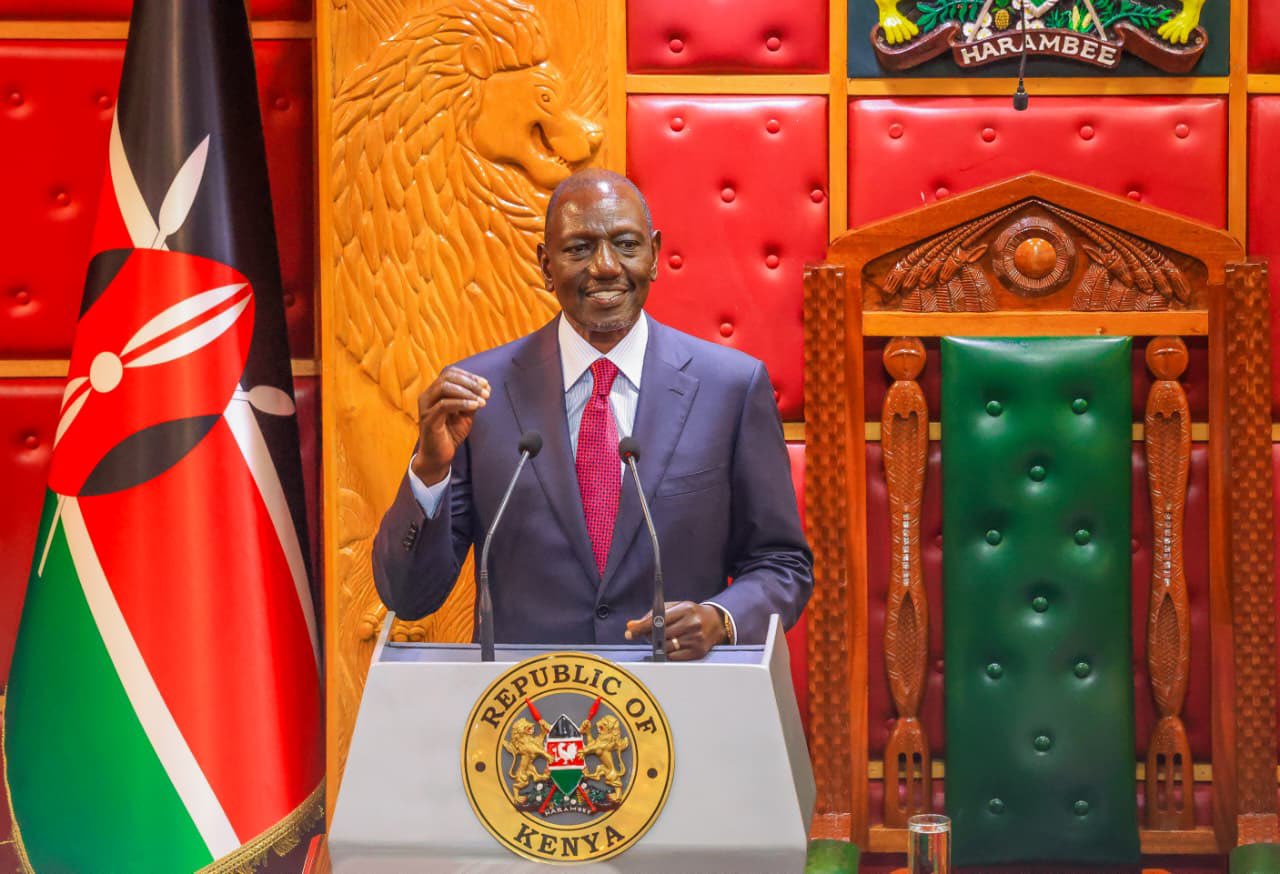
President William Ruto told a joint sitting of Parliament on Wednesday that Kenya has moved from the brink of default in 2022 to a more stable and resilient economy, citing a stronger shilling, lower inflation and reduced lending rates.
“In 2022, we inherited an economy on the brink of collapse, with the country at the risk of defaulting on its international debt obligations,” the President said. “Through deliberate policy interventions and prudent economic management, we have stabilised the economy and placed Kenya on a path of renewed growth, making it one of the most vibrant and resilient economies in Africa.”
He reported that the Kenya shilling has stabilised at around KSh 129 to the US dollar after recovering from nearly KSh 162. Inflation averaged 4.1 per cent in 2025, down from 9.6 per cent in 2022, although he noted renewed pressure from food and energy prices in October 2026. Commercial bank lending rates fell from 17.2 per cent in November 2024 to 14.4 per cent in September 2026.
Foreign exchange reserves rose from $7.37 billion in 2022 to a peak of $15.3 billion this year, and the government honoured a $2 billion Eurobond obligation that fell due in June 2024. Ruto argued these indicators help businesses plan, farmers produce, investors create jobs and households protect their purchasing power.
He also announced proposals to further ease pressure on households, including exempting workers earning KSh 32,333 or less per month from PAYE, removing stamp duty on land transactions of KSh 1 million or less, and scrapping the 25 per cent import duty on mobile phones. The administration has also approved settlement of 28,726 verified pending bills totalling KSh 27.8 billion.
Ruto described the progress as the outcome of the Bottom-Up Economic Transformation Agenda and stressed that the work remains unfinished. He called for continued reforms to make everyday life more affordable and more rewarding for every Kenyan.
Agricultural Reforms Deliver Higher Production and Better Farmer Earnings
President Ruto said agricultural reforms are translating into increased production, improved productivity and higher earnings across key value chains including maize, tea, coffee, sugar and dairy.
The price of a 50-kilogramme bag of fertiliser fell from KSh 7,500 in 2022 to KSh 2,000 this year, with 38.5 million bags of subsidised fertiliser distributed and nearly nine million farmers registered. Access to improved seeds, soil testing and extension services has also expanded.
National maize production rose from 44.3 million bags in 2022 to 71 million bags last year, while imports declined from 9.9 million to 3.3 million bags. The average price of a two-kilogramme packet of sifted maize flour dropped from a high of KSh 230 in September 2022 to KSh 152 in September 2026.
In coffee, export earnings doubled from KSh 26 billion to KSh 52.1 billion, with average cherry prices rising and the Cherry Advance Revolving Fund disbursing KSh 15.07 billion to 684,000 farmers. Tea export earnings increased from KSh 163 billion in 2022 to KSh 187 billion in 2025. The President also highlighted recovery in the sugar and dairy sectors, including a KSh 1.2 billion bonus package for sugarcane farmers whose disbursement is set to begin next week.
He framed the gains as part of a broader effort to reduce production costs for farmers, increase food supply for consumers and ensure better returns for producers.
Infrastructure Push, Housing and Overseas Jobs Feature in Address
President Ruto outlined major infrastructure, housing and employment measures, saying the government is building 7,000 kilometres of roads across the country, including the completion of projects that had stalled for years. The Rironi-Mau Summit road and the Horn of Africa Gateway Development Project in Northern Kenya are progressing, while expansion of Jomo Kenyatta International Airport has begun and modernisation is under way at the ports of Mombasa and Lamu.
Through the National Infrastructure Fund—capitalised with KSh 340 billion from the divestiture of mature public assets—the government plans to dual the Nairobi-Mombasa highway and finance other strategic projects without further straining public debt. The broader transformation programme is estimated to require KSh 5 trillion over the next 10 years. Ruto also announced plans for at least 50 mega dams, 200 medium and small dams, and thousands of water-harvesting structures to support a target of 2.5 million acres under irrigation, alongside an additional 10,000 megawatts of electricity generation capacity.
On housing, more than 313,000 homes are at various stages of construction under the Affordable Housing Programme, creating over 1.1 million jobs. More than 18,000 units have been allocated and over 1.3 million Kenyans are registered on the Boma Yangu platform. The overseas employment programme has placed 707,000 Kenyans in jobs abroad.
Ruto said these investments form part of a long-term effort to expand productive capacity, connect producers to markets and raise living standards across all 47 counties under the principle of “Usawa ni Sawa”.
Education and Healthcare Expansion Marked as Key Gains
In education, the administration has recruited 100,000 teachers to address a shortage previously estimated at 116,000 and plans to hire an additional 20,000 in the coming months. It has constructed 23,000 classrooms and is building and equipping 1,600 laboratories. The Competency-Based Education curriculum has been aligned to the demands of a changing society, and the Tertiary Education Placement and Funding Bill currently before Parliament is intended to strengthen equity and fairness in access to higher education.
On healthcare, 33.7 million Kenyans are registered under the Social Health Authority, up from approximately eight million under the former National Hospital Insurance Fund. The President said the expansion significantly improves access to affordable healthcare.
He acknowledged that the task remains far from complete and pledged to deepen reforms so that economic stability, infrastructure, education and health services continue to improve daily life for ordinary Kenyans.