
Nairobi, November 12, 2026
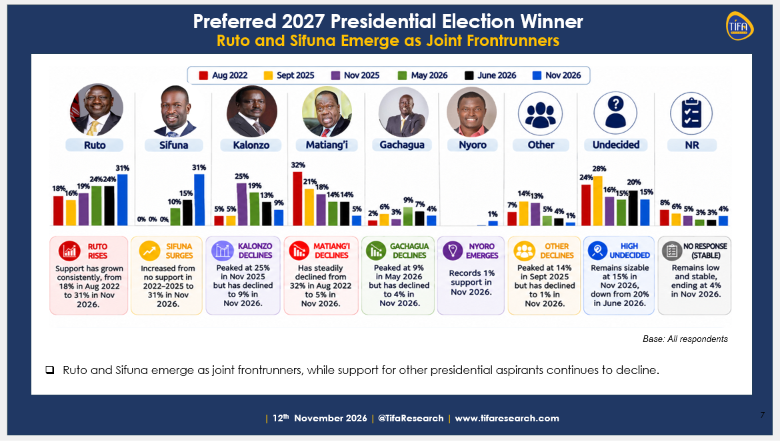
President William Ruto and Nairobi Senator Edwin Sifuna are now locked in a dead heat as Kenyans’ most preferred candidates for the 2027 presidential election, according to a new national opinion poll released on Thursday by Trends and Insights for Africa (TIFA) Research. Both men poll at 31 per cent, marking sharp gains from earlier TIFA surveys in which Ruto stood at 24 per cent and Sifuna at 15 per cent. The-star
The findings, drawn from interviews covering all respondents, signal a more competitive and fluid race roughly nine months before the August 2027 General Election. They also highlight a notable realignment in party support: the United Democratic Alliance (UDA) leads as the most popular political party at 25 per cent, followed by the Linda Mwananchi movement at 17 per cent and the Orange Democratic Movement (ODM) at 10 per cent. X
Presidential Preference: A Dramatic Climb for Sifuna
Sifuna’s rise has been one of the most striking features of recent polling. He registered virtually no measurable support in TIFA surveys in August 2022, September 2025 and November 2025. By May 2026 he had reached 10 per cent, climbed to 15 per cent in June, and has now surged to 31 per cent. Ruto’s path has been steadier: 18 per cent in August 2022, 16 per cent in September 2025, 19 per cent in November 2025, 24 per cent in both May and June 2026, and now 31 per cent. The-star
Other prominent figures have lost ground. Former Interior Cabinet Secretary Fred Matiang’i, who once topped some rankings at 32 per cent in August 2022, has fallen to just 5 per cent. Former Vice-President Kalonzo Musyoka, who peaked at 25 per cent in November 2025, is now at 9 per cent. Former Deputy President Rigathi Gachagua stands at 4 per cent after earlier readings in the single digits. Support for other potential candidates has dropped to about 1 per cent. Undecided respondents account for 15 per cent (down from 20 per cent in June), while 4 per cent gave no response. The-star
These figures reflect stated preferences at the time of the survey and are not predictions of the final result. Alliances, campaign platforms, candidate declarations and events between now and election day can still reshape the contest. Under Kenya’s Constitution, a candidate must secure more than 50 per cent of the vote plus one to win outright; a run-off is required otherwise. With the top two candidates each at 31 per cent and a large share of voters still undecided or supporting others, the race remains open.
Party Support: UDA Ahead, Linda Mwananchi Gains, ODM Declines
On party identification, UDA leads with 25 per cent support. Linda Mwananchi, the movement associated with Sifuna and other leaders who have distanced themselves from continued cooperation with the government, follows at 17 percent. ODM has fallen to 10 percent. The data points to fragmentation within the traditional opposition, particularly ODM, where internal debates over strategy, including the broad-based government arrangement, have produced competing factions such as Linda Mwananchi and Linda Ground. X
Earlier TIFA surveys had shown ODM as one of the stronger parties nationally in some periods, but the latest numbers indicate a shift, with Linda Mwananchi emerging as a significant vehicle for those seeking a more independent opposition posture. UDA’s lead is consistent with its position as the ruling party, though overall party loyalty remains relatively modest and a substantial portion of Kenyans continue to withhold firm identification with any single formation.
Context and What the Numbers Suggest
Sifuna’s rapid ascent from near-zero support in late 2025 to joint first place has elevated him as a central figure in opposition discussions. His association with Linda Mwananchi appears to have helped consolidate support among voters seeking an alternative to both the ruling party and more established opposition leaders. For Ruto, the increase from 24 per cent to 31 per cent suggests some recovery in stated preference, even as the overall field remains competitive and large numbers of voters stay uncommitted.
The poll underscores persistent challenges for the opposition in uniting behind a single ticket. Support remains dispersed among several names, and earlier TIFA work has shown no single opposition pairing clearly dominating among those opposed to the incumbent. Cost-of-living pressures, economic conditions, governance issues and perceptions of the broad-based government arrangement continue to shape the broader political mood, according to related surveys.
As Kenya moves closer to the 2027 polls, these TIFA numbers provide a snapshot of current voter sentiment rather than a forecast. They illustrate both the incumbent’s improved standing and the sudden prominence of a relatively new opposition contender, while highlighting how party loyalties and candidate preferences can shift quickly in a fluid pre-election environment. Further surveys in the coming months will show whether the current tie holds or whether new alliances and campaign dynamics alter the picture.